
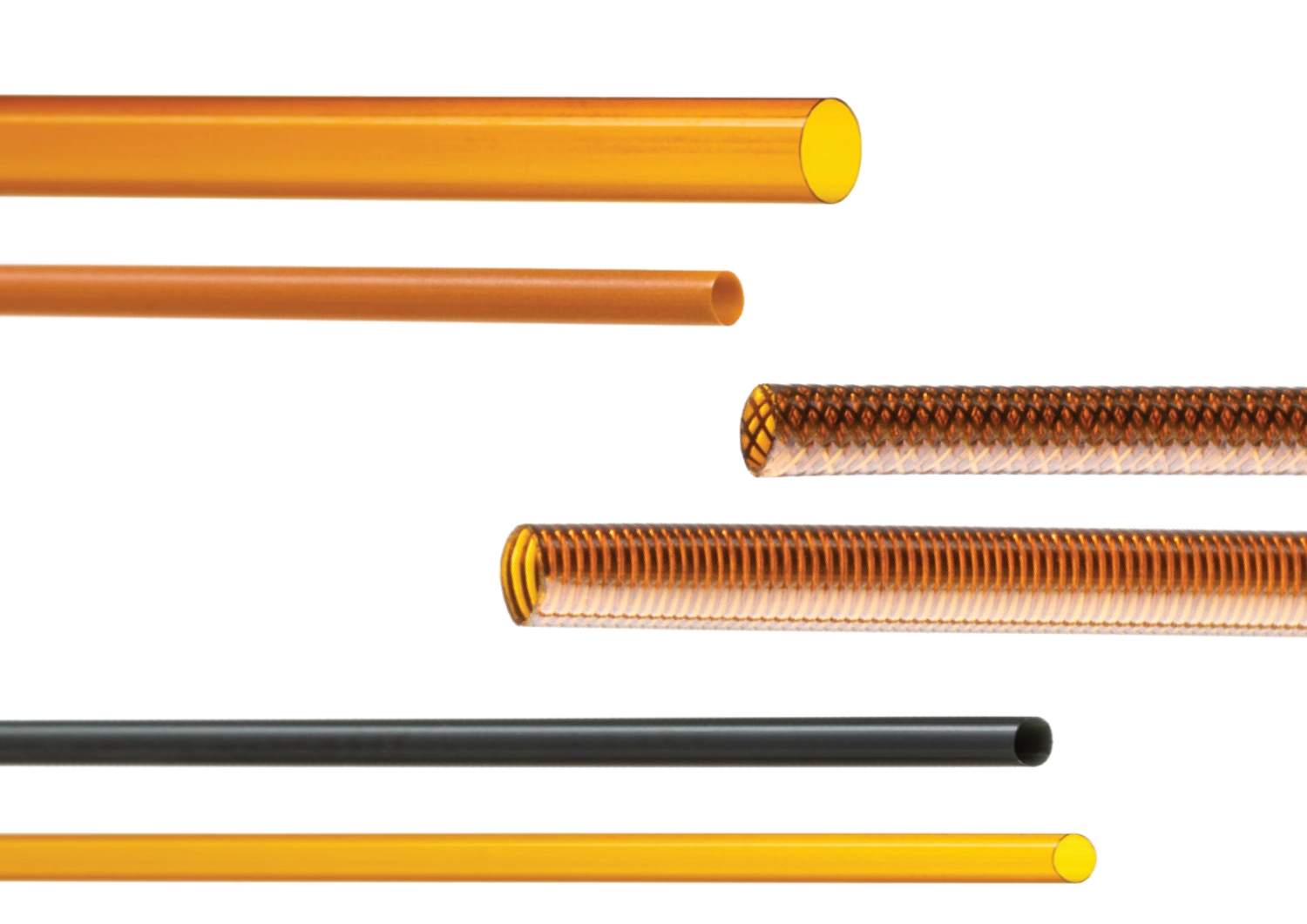
| Technical Data | PI Tubing | Braided PI Tubing |
Inner Diameter | 0.1-2.3 mm | 0.245-2.3 mm |
Inner Diameter Tolerance | ± 0.01 mm | ± 0.0051-0.025 mm |
Wall Thickness | 0.0076-0.2 mm | 0.05-0.2 mm |
Wall Thickness Tolerance | ± 0.006 mm | ± 25% |
Tensile Strength | 239 Mpa | / |
| Continuous Operating Temperature | 350 ℃ | 350 ℃ |
| Length | Custom | |
| Biocompatibility | Meets USP Class VI and ISO 10993 requirements | |
1. Standard PI Tubing
This is a high-performance polymer precision tubing with ultra-thin walls and high-precision tolerances. It offers a great balance of properties: high tensile strength, excellent kink resistance, and long-term extreme temperature resistance. It also has great electrical insulation and chemical resistance. The product is certified for medical-grade biocompatibility, safe, and non-toxic. It is a must-have micro-lumen core material for high-end medical devices and industrial uses.
2. PI Braided Reinforced Tubing (Composite Polyimide Tubing)
This is an upgraded version of pure PI tubing. It adds a high-strength, micro-fine metal wire or fiber braided layer inside the tube using a precision braiding process. It keeps all the benefits of standard PI tubing—like ultra-thin walls, high precision, extreme temperature resistance, and medical-grade safety—but greatly improves mechanical strength. This braided layer brings excellent kink resistance and a 1:1 torque response. It ensures the lumen does not collapse and stays smooth to control, even in complex, tortuous pathways or vasculature.
Medical Devices (Minimally Invasive Interventional)
· Cardiovascular & Peripheral Intervention: Used as balloon dilatation catheter liners, stent delivery system outer sheaths, and introducer sheaths.
· Neurointervention: Used in ultra-fine tubing systems like cerebrovascular microcatheters and distal thrombus aspiration catheters.
· Endoscopy Systems: Used as wear-resistant and high-pressure working channels for minimally invasive endoscopic surgical instruments.
· Electrophysiology & Ablation: Used as the core insulation sleeve for radiofrequency and cryoablation catheters to protect non-treatment zones.
